

Ulysses and Raquel got married last Friday. Now they’re enjoying their one month honeymoon in Guanajuato. I love that place.
Ulysses and Raquel got married last Friday. Now they’re enjoying their one month honeymoon in Guanajuato. I love that place.

Marco helped me relocate a couple security cameras recently. I needed his help adjusting the focus.

We had some spectacular carne asada last Sunday.
Dr. Liam Goligher – The Eye-Opener
Isa 49.6 is where the light of the world originates.
From this light, some will be able to see, but for others, it increases their blindness
The miracle is set against the background of a human tragedy
We know the man was a familiar figure, the neighbors know him
This whole thing starts because Jesus is looking at this man
Sometimes we would rather ignore these people because they make us uncomfortable
Our natural reaction is to see and avoid
We have been seen and touched.
This question has already been addressed in the Bible. The Book of Job.
Despite that book, one of the oldest books, still this idea of a direct causal relationship between a particular sin and particular sickness still remains in Jesus’ day.
We want to have a solution, or an explanation, for things.
Exodis 20.5 They thought that was a verse that gave them some biblical support
Some rabbis believed babies could sin in the mother’s womb
This probably wasn’t the most sensitive thing for them to do in front of this man
This man’s condition is within the orbit of the sovereignty of God
(And also YOUR condition is within the orbit of God’s sovereignty)
The physical horrors of suffering are meant to demonstrate to us the moral horrors of sin
They are a reminder to humanity that there is something worse than being sick
There is something worse than physical death
These are the sacraments of spiritual death – they are the outward sign of a spiritual reality.
Exodus 4.1 – God causes blindnes
You formed my inward parts, you knitted me together
That the works of God will be displayed in him.
He’s saying this, you want to know if there is a reason. You want to know the cause. I am not going to discuss that with you because it’s beyond your ability. I want you to ponder the purposes of God. There is no suffering outside the purposes of God. Jesus doesn’t emphasize the cause, but he emphasizes what is about to happen. In this case, there will be healing. But there is nothing in the bible that says it has to be by healing. Hhealing is not the only way that God is glorified.
Remember Paul had a physical ailment. He prayed for it to be taken away. Three times the Lord refuses. My grace is sufficient for you. My power is made perfect by your weakness. My power will be demonstrated by sustaining you. By enabling you in spite of the suffering.
He is the sent one from God. Register that word.
There is an urgency in doing the work of God. Night represents spiritual darkness. This is the day of opportunity.
We must work the works of God while it is day.
There will now be a physical demonstration of what it means to be the light of the world.
This is a creative act, not a restorative act. This man never had vision, so he isn’t restoring his vision, he’s creating vision.
He is double blinding the man by putting mud in his eyes. He is prophetically demonstrated what happens when you reject the truth. What does God do, he blinds them. He prevents them from seeing what they don’t want to see. He is symbolizing the judement that is coming among Israel. He demonstrates the only place a human being blinded.
Siloam:Southwest in the city of David. In Hebrew, Shiloah.
The mud is blinding the man. This symbolizes the judgement coming upon Israel.
The name of the pool in Hebrew is called Shiloah. It’s origin Gen 49.10 which talks about the coming of the Messiah. The sceptre will not depart from Judah until Shiloah come. Both Jews and Christians believe that to be a refernce to the Messiah.
Go an wash, in the pool of Shiloah.
Isa 8.6 the rebelious people of Judah are accused of rejecting Shiloa. They have refused the waters of Shiloah. Just as the people of Jesus’ day were rejecting the Sent one.
By sending this man to Shiloah, it is the water of the pool of the Messiah.
Having gone and washed, he came back seeing.
He had been a blind beggar. The truly poor. He gives his testimony. A man named Jesus…so Iwent and washed and received my sight. He just said what he knew. He bore witness that Jesus gives sight to the blind.
———————————————————-
When youre losing the argument, you go to invective. John, are we not right that you are as samaritan and have a demon. This is criticism from left field. Here in John 8 it is just a dismissal. We know longer regard you as an orthodox Jew.
And his disciples asked him, “Rabbi, who sinned, this man or his parents, that he was born blind?”
The question is raised by the disciples. In order for it to be raised (plural), it must have been previously discussed, or a question that came immediately to their minds when they saw the blind man. Perhaps they were moved by compassion by the suffering of the blind man and wondered to themselves, why does God allow this sort of thing to happen? Why is there suffering? How do you reconcile the goodness of God with the misery found in creation?
The answer was sin. It’s the correct answer, but these disciples (and perhaps the trend among that time) had assumed that personal suffering must be the result of a specific sin.
But this man was born blind. How did the disciples know this man was born blind? Verse 1 says Jesus saw a man blind from birth. Jesus must have revealed the situation about this man to the disciples. Otherwise, how would they have known? At any rate, whomever or whatever revealed that this blindness was from birth, it seems that this revelation is what prompted their question. Maybe Jesus pointed out the man to the disciples and advised he had been born blind which immediately prompted something that was on each of their minds. Why? Why was that man born blind?
This was a theological question they had hoped Jesus would resolve. But Jesus’ response shows that they were asking the wrong questions. This man’s suffering was not the result of a specific sin (though obviously Jesus isn’t saying this man is without sin, nor his parents for that matter).
Jesus answered, “It was not that this man sinned, or his parents, but that the works of God might be displayed in him.
Remember, this is the Sabbath. And Jesus is here talking about work. God doesn’t stop working on the Sabbath. The works are to be displayed. This miracle is meant to be revelatory. And that was the purpose of this man’s blindness. Its intent was to reveal God. That this blind man would display, or be the display, of God’s work.
But God chose what is foolish in the world to shame the wise; God chose what is weak in the world to shame the strong; (1cor 1.27)
The disciples were trying to unravel a theological mystery of their day. They ask Jesus, is this man suffering from A, or is it because of B? And Jesus responds: no.
Jesus says that this blindness was to display the work of God. And then goes on to say:
We must work the works of him who sent me while it is day; night is coming, when no one can work. As long as I am in the world, I am the light of the world.
Jesus is pointing out that their time is limited. They have work to do (we must work…) There will be a time when they can no longer do this work. And Jesus alludes to himself as the one who is SENT. That’s a significant connection to the Pool of Siloam which will be introduced shortly.
He then identifies himself as the ‘light of the world’. Jesus regularly identifies as the light of the world:
Again Jesus spoke to them, saying, “I am the light of the world. Whoever follows me will not walk in darkness, but will have the light of life.” (John 8.12)
See also; John 1.9, 3.19, 11.9, 12.46. Jesus is the light, and we are called sons (or children) of light.
For you are all children of light, children of the day. We are not of the night or of the darkness. (1Thes. 5.5)
While you have the light, believe in the light, that you may become sons of light.” When Jesus had said these things, he departed and hid himself from them. (John 12.36)
And then verse 6. The disciples and Jesus discuss the blind man. And then without any recorded verbal exchange with the guy, Jesus proceeds to make mud with spit to put in his eyes.
Having said these things, he spit on the ground and made mud with the saliva. Then he anointed the man’s eyes with the mud
That had to be a good amount of spit. As one sermon shared yesterday, that might have been seen as somewhat offensive. Or just plain gross. Which is in every way symbolic of the gospel. To those perishing, the gospel is offensive. It is folly.
For the word of the cross is folly to those who are perishing, but to us who are being saved it is the power of God. (1Cor 1.18)
Spitty mud balls in the eyes is culturally offensive. It offends our good taste. It seems improper. It was not sanitary. There’s nothing medicinal about spitty mud (despite certain claims to the contrary). There’s no mistaking the miracle as coming from Jesus, because the mud most certainly wouldn’t heal a man.
People recoil from the gospel just as they would recoil from someone making mud with spit and putting into someone’s eyes. We see that in this very chapter with the Pharisees.
and said to him, “Go, wash in the pool of Siloam” (which means Sent). So he went and washed and came back seeing
It’s interesting to note thus far in the story that we have not heard a word from this man. Jesus just put spitty mud in his eyes and then directs him to go wash that mud in a pool called Siloam, which means Sent.
This pool was just discovered 11 years ago in 2004. It is in the south of Jerusalem. The blind man was sent to the pool called Sent. This was the first thing he would have seen. He would see water for the first time. The blind man was obviously familiar with water. But he would have no idea what it would have looked like. How would you even describe water to someone born blind? And then he returns to where he was, but now he can see.
The neighbors and those who had seen him before as a beggar were saying, “Is this not the man who used to sit and beg?” Some said, “It is he.” Others said, “No, but he is like him.” He kept saying, “I am the man.”
All sorts of confusion here. You see a guy every day in your neighborhood. He’s blind. He’s always been blind. Now he looks different. Similar. But different. Most certainly his eyes would have looked differently. Because, now they’re working. He’s now able to make eye contact. He wouldn’t be able to do that before. A man born blind has never become not blind. So what are they to make of this? The whole neighborhood probably caught fire with curiosity. The man had changed. He’s different now. But it’s the same man. He keeps insisting it’s him. This sounds all too familiar. Like a conversion story. Same guy. But he’s different. He’s been changed.
So they said to him, “Then how were your eyes opened?” He answered, “The man called Jesus made mud and anointed my eyes and said to me, ‘Go to Siloam and wash.’ So I went and washed and received my sight.”
Previously I had assumed there was no interaction with Jesus and this man. As if Jesus had just walked up to him, put some spitty mud in his eyes, and then sent him to Siloam. But then, how did he know the man was Jesus? At some point there had to have been an introduction. But we aren’t given that information. It suggests that there’s more details to the story than we’re given. So minimally, we know the guy, prior to being sent to Siloam, was somehow able to get Jesus’ name. Maybe there was even more discussion than that. But we don’t know. Because John didn’t record that part.
And if I was this guy’s neighbor, I’d be thinking, “say whhhaat?” I don’t think that explanation would make any sense. Ok, so you met some guy named Jesus. He made mud? And then he anointed your eyes? He told you to go to the Pool of Siloam to wash. And then somehow you received sight? That would probably had led me back to my initial question. But how were your eyes opened?
Now this Pool Siloam. We were told in verse 7 that it means “Sent”. In verse 4, Jesus references being the one sent. To me, the significance of a pool named Sent, seems to reference Jesus as the one being sent to do the works of God. Jesus frequently refers to himself as the one sent from God throughout the New Testament, but most frequently in the Book of John.
So there’s this sense that the Pool of Siloam is in some ways symbolic of Jesus. The man is sent to this pool to wash and to be healed, just as all who are drawn to the father through the son. Jesus in John 6.65 says, “He went on to say, “This is why I told you that no one can come to me unless the Father has enabled them.””
They said to him, “Where is he?” He said, “I do not know.”
This reminds me of the guy in John 5. Jesus heals him, and then departs. And when asked by others where Jesus is, neither one of them know. Jesus heals these men, and then leaves. And then these men are confronted by opposition.
It’s not as if Jesus has abandoned these men. We see him following up with each of them later. But he physically departs. Their lives have changed. And then the opposition moves in. That’s a story I can identify with. It reminds me of my college years.
They brought to the Pharisees the man who had formerly been blind
This was just a matter of custom. A miracle had allegedly taken place and so the religious authorities must be brought in. There was nothing wrong with bringing this man to the authorities. For the same reason, there was nothing wrong with the man of John 5 reporting the miracle of Jesus to the authorities. It was their obligation to do so.
Now it was a Sabbath day when Jesus made the mud and opened his eyes
Jesus intentionally picks the Sabbath to do these things. Jesus knows the antagonism these things will cause when done on the Sabbath. Jesus is clearly trying to stir the pot. He wants to expose the hypocrisy of the religious. So they bring the blind man to be tried by the Pharisees.
So the Pharisees again asked him how he had received his sight. And he said to them, “He put mud on my eyes, and I washed, and I see.” Some of the Pharisees said, “This man is not from God, for he does not keep the Sabbath.” But others said, “How can a man who is a sinner do such signs?” And there was a division among them. So they said again to the blind man, “What do you say about him, since he has opened your eyes?” He said, “He is a prophet.”
So now it’s the Pharisees turn to hear the story. Immediately the objection is raised that Jesus cannot be from God because he has violated their understanding of the Sabbath. Of course, they don’t even think to question their oral traditions surrounding the Sabbath. But here other Pharisees (those that think as Nicodemus or Gamilel) question how a sinner (ie Sabbath breaker) can possibly do such things. So a dispute arose.
Here’s what they had to work with at this point:
1) Sinners cannot do these sorts of signs
2) Sabbath breakers are sinners
3) A man named Jesus performed a sign that sinners cannot perform
4) Spitting into mud and putting it on someone’s eyes is a violation of the Sabbath
Some there (obviously the minority) saw the problem in reconciling the undisputed 1-3, with 4. That is, If 1, 2, and 3 are given as truth, then 4 cannot be true (without a contradiction).
Others, clearly the majority, saw that if 1,2, and 4 were given as true, then 3 could not be true (that is, the miracle was a fake).
So strangely, they now appeal to the blind man to resolve this dilemma. Who do you say this man is? And the blind man has very little knowledge of who Jesus is at this point. He has his name, and he knows that he has performed a miraculous sign that no one has ever seen before. So he labels Jesus with the highest designation he can to a man. A prophet.
Naturally they don’t like that answer.
The Jews did not believe that he had been blind and had received his sight, until they called the parents of the man who had received his sight and asked them, “Is this your son, who you say was born blind? How then does he now see?”
If 4 above is taken as true, then at least one of the propositions 1-3 cannot be true. So naturally they’re going to deny 3. The miracle didn’t happen. That’s the only way they can retain 4. So to prove that the miracle is fake, they call the guy’s parents.
As a reminder, the text gives no indication as to the man’s age. Because he’s referred to as a man, we only know that he’s at least 13 years old or older. I have a tendency of envisioning someone much older. But the text really doesn’t specify. He could easily just be a kid by today’s standards. Given some of his sarcastic comments later, I’m now more inclined to see him as a kid. A smart one at that.
His parents answered, “We know that this is our son and that he was born blind. But how he now sees we do not know, nor do we know who opened his eyes. Ask him; he is of age. He will speak for himself.”
The fact that the parents feel the need to explain that their son is ‘of age’ leads me to believe that if there was really any question of this, then he must have looked young. Of course, that could just be there way of saying they didn’t want anything to do with this.
Now I have a feeling the parents aren’t being truthful here. They fear the Pharisees. They were asked three questions. Yes, this is their son. Yes, he was born blind. But when it comes to how he was given sight, they say they didn’t know. They had to have the same explanation that everyone else was given. Perhaps if they agreed to that explanation, then they thought they would have run into trouble with the obvious implications regarding 4 above (ie, it’s bogus belief).
So once again, this guy is on trial and left alone. His parents will not be speaking for him.
(His parents said these things because they feared the Jews, for the Jews had already agreed that if anyone should confess Jesus to be Christ, he was to be put out of the synagogue.)
This passage seems to suggest that the parents were not entirely forthright, but instead, were crippled by their fear of being excommunicated.
This passage also seems to suggest that it was at sometime prior when the Jewish leaders made this proclamation regarding Jesus. After all, when asked about this miracle, the parents already knew the Pharisees’ disposition toward Jesus. That might suggest there is a greater gap in time between chapter 8 and 9 than is often given. Between the Feast of Booths in chapter 7 and the Feast of Dedication in chapter 10, there’s a gap. We just don’t know exactly where that is in the text.
At any rate, some prior event involving Jesus had caused the religious authorities to ban anyone from confessing Jesus to be the Messiah. To do so would entail excommunication. Now if the parents knew about this threat of excommunication, it seems reasonable that their son would also have known of this threat. That’s significant because if he did know, it certainly didn’t deter him in the least as it did his parents.
So for the second time they called the man who had been blind and said to him, “Give glory to God. We know that this man is a sinner.”
This is very strange. I’m at a loss as to what they were expecting this guy to say. Was he supposed to renounce the miracle as not really happening? Then how could he now see? Were they expecting him to lie about it? The implication in the imperative to give God glory is that he hasn’t been doing that. But quite to the contrary, that’s exactly what he’s been doing. The irony. And their arguing in circles. Sinners cannot perform these sort of signs. This sign has been confirmed as authentic. So how can they possibly conclude that this man is a sinner? They would have to contradict a prior belief they’ve maintained. They would have to now say that sinners can perform these signs.
He answered, “Whether he is a sinner I do not know. One thing I do know, that though I was blind, now I see.”
He seems to change his mind shortly when he concludes a sinner could not do these things. So it does seem that he does know that Jesus is not a sinner, based upon the reasoning he offers (which is the same reasoning that causes the division among the authorities). I think his response is intended to indicate that he just met Jesus. He doesn’t know anything other than he was blind, now he sees, and Jesus was responsible for that. He’s just sticking with the facts. He’s not speculating as the Pharisees have done due to their prejudicial commitments.
They said to him, “What did he do to you? How did he open your eyes?”
Clearly they’re struggling here. They know there’s a contradiction. So they keep probing, senselessly, in an effort to find some way to undermine this work as miraculous. The guy has already answered this question. But they have no where else to go. In a sense, they’re being exposed for their hypocrisy. And I think this guy is starting to get annoyed:
He answered them, “I have told you already, and you would not listen. Why do you want to hear it again? Do you also want to become his disciples?”
The story is not changing. But they want him to keep repeating it. He’s exposing their desperation. They’re helplessness. They’re defeat. So in what seems like mockery in the form of sarcasm, he asks, do you ALSO want to become his disciples? The clear implication is that HE wants to be a disciple of Jesus. That’s clearly grounds for excommunication. He doesn’t care. These guys have been exposed for what they are. He wants to be identified with Jesus. Christians love to hear the Gospel stories over and over again. He’s making fun of them by suggesting this is why they want to hear the story again. I have to imagine not a small number of people that had gathered around to witness this spectacle must have chuckled by this guy’s question. That would most assuredly enrage these hypocrites all the more.
And they reviled him, saying, “You are his disciple, but we are disciples of Moses. We know that God has spoken to Moses, but as for this man, we do not know where he comes from.”
They intend it as an insult to call him a disciple of Jesus. He’s already made it clear he wants to be a disciple. That insult doesn’t work here. But they’re too dense to get it. And then they boast of being disciples of Moses. Nothing could be more blatantly false. Moses gave them a written text, codified in the Torah. He had nothing to do with their oral traditions. And those oral traditions had nothing to do with Moses. Number 4 above did not come from Moses. It came from their oral tradition. A tradition which in fact contradicts Moses.
By their own admission, they didn’t research the origin of Jesus. So they concede the point. They don’t know where Jesus comes from. So to say that he doesn’t come from God would contradict that very point. It’s as absurd as someone saying they don’t know anything (then how do they know that?).
And this non-named fellow picks up on this.
The man answered, “Why, this is an amazing thing! You do not know where he comes from, and yet he opened my eyes. We know that God does not listen to sinners, but if anyone is a worshiper of God and does his will, God listens to him. Never since the world began has it been heard that anyone opened the eyes of a man born blind. If this man were not from God, he could do nothing.”
He’s obviously much smarter than they had given him credit. He’s defeated and deflated them. He points out their admission. They don’t know where Jesus comes from. Well that’s obviously a problem. Maybe they should figure that out FIRST before pontificating on where he comes from (ie, not God). They are spewing overt contradictions.
He AGAIN points to the fact that sinners cannot perform signs like this. They concede this. He points out the obvious. If Jesus was not from God, then he could do nothing. It’s an irrefutable argument. They don’t disagree with that point. Their former strategy of denying the miraculous event has obviously failed miserably. So they’ve got nothing. And this guy has become very bold. This illiterate (blind people cannot be taught to read/write when braille doesn’t exist) man (at least, over 13) has put these ‘leaders’ to shame. He’s humiliated them publicly. And now, he will pay for his actions the only way they know how.
Just like when Jesus refutes the ignorance of his opposition in John 8, they are left with nothing other than to hurl insults. And this is precisely what they do:
They answered him, “You were born in utter sin, and would you teach us?” And they cast him out.
But even their insults are pathetic. The sin that this blind man was born in was no different than these blind leaders were born in. They’re basically just calling him a cripple. And he must be a cripple because something someone else did, or because he broke God’s law in the womb. Their theology is embarrassing. Their arguments and insults likewise.
And I doubt their insults would mean anything to this man. He could probably laugh at them. He’s heard this argument about the origin of his blindness his entire life. And that’s the best these well-educated scholars could do? They have only one thing left in their arsenal. Excommunicate him. And that’s what they’ve done. Casting him out is an expression denoting excommunication. He was cast out of the synagogue. Out of Israel. And I’d like to imagine he thought, good riddance.
…and would you teach us?
Yea son, you just got owned. :p
Jesus leaves the religious to go and work
The pool of siloam was discovered in 2004, the pool previously identified was wrong
The pool of siloam and hezekiah
Nehemiah 3 mentions siloam
Siloam is in the south of Jerusalem
The pool would have been the first thing the man would have seen
John 9 takes place in Jerusalem at the feast of booths (something to do with water)
They’re looking at the cause of this man’s blindness
The thing to look at is how God is going to be glorified in this situation
Why is this happening? Jesus’ people’s first reaction should be ‘how does God mean to glorify himself?”
In what way is this going to advance the purposes of God?
How can God be glorified in this situation?
Jesus is acting out a parabale in this man’s life by using the mud
Siloam means sent – why does John tell us?
Jesus is reacting in parable form the creation of man when God took the dust of the earth
Adam was made from the dust of the earth
Sinclair Ferguson believes this is Jesus re-enacting, a symbol, of creation
Re-creation, regeneration
The feast of tabernacle and the pool of siloam
The pool is Sent – when we are able to see, we too go to Jesus
They were blind to the blind man, they couldn’t see
You should not be kneading on the sabbath day – the pharisaic conclusion
But some were good men. A division.
They get the man’s parents who are obviously intimidated out of their minds
They can’t get this man, so they go after the one’s he loves, his parents
“He’s old enough” which would suggest he might be young
They reviled him – like Jesus. He is becoming like Jesus. Everything was at stake. Excommunication.
His boldness increases, he’s almost taunting them now.
The prophets in the old testament would taunt the unbelievers
You don’t know where he comes from. You are supposed to know everything.
They cast him out – that means, they excommunicated him.
So Jesus comes to him.
V11, the man that healed him, then the prophet, then the one that was sent to save him, now the Son of Man
His understanding of Jesus advances
Lord I believe. And he worshipped him.
Jesus opens the eyes of those born blind. When Jesus opens blind eyes, we become worshippers of him, we become like this man enboldened. We become prepared to count everything as lost when compared to the excellence of Jesus.
If you were physically blind, you would have no guilt, your guilt remains.
———————————————————————————————–
Phil Johnson
Healing of physical blindness, healing of spiritual blindness
This miracle occurs at a dangerous time in Jesus’ ministry
Jesus was calling the pharisees murderers and liars
Jesus calls them the children of the devil
This was a huge confrontation which infuriated them
Jesus took the name God used when he appeared to Moses in Exodus 14
He was telling the pharisees that he was their God
Because of their spiritual blindness, they wanted to kill Jesus
Jesus’ life was in real danger at that point
They hated Jesus, but he doesn’t stop doing these things.
Jesus continues to demonstrate his deity. He affirmed his deity, now he displays his deity.
Jesus life was in peril, but he turns aside to help one individual in need
His mercy contrasts with their hatred
They wanted to know who’s fault it was that this man sufferee
Why is there suffering? Why do some suffer more? Why would God allow anyone to suffer from birth?
How is it just for someone to suffer from some one elses sin?
Trials and suffering are always a result of sin. Theirbelief. Our society has gone to the other end of the spectrum.
David is an example. His troubles were often the consequence of his sin. Think of their first baby.
Personal suffering is the direct result of personal sin. Thats what they were taught.
But what about babies born with disabilities? This was a debated issue. Between the rabis. Some believed it was due to the parents sin. Some believed its because of sin in the womb. Thatc dilema is what was in their mind. They believed he had an answer.
Jesus’ answer is simple. He doesn’t go into detail. Instead, he focuses on the work.
Jesus answer is succint. He doesn’t explain the mystery of pain and suffering. He doesn’t even try. He doesn’t do anything to speculate or inquire further. He gives them a simple answer and then he turns his attention to the work at hand.
Deut 29:29 the secret things belong to the lord our God — so that we may DO the words of this law.
God has given us work to do and our task is to do it without being diveted by vain speculation
Spurgeon says “it is ours not to speculate, but to perform acts of mercy and love”
Jesus was not saying this man or his parents were sinless. He was simply saying their personal acts of sin were not the cause of their blindness. He was blind by God’s design. Does that seem fair? What do you think this man would say today if we could ask him today?
This was an ocasion for God to display his glory.
The physical healing is symbolic of a greater work
There are no human co-wrkers here. Jesus alone does this work. All the work of redemption is his work. Eph 2.10
We dont participate in being given sight.
Christ is the light of the world. Night is coming he says.
Vs 5 – Iam the light of the world. Day time is over.
This is clear echo of his deity claims in john 8 – look at verse 12 “Iam the light of the world”
This was th estatement that began that conflict in chapter 8. He was making claims only God could make, but they didnt believe him.
John 1.5 ‘ the darness comprehended it not’
Men loved darkness rather than light
All of those were familiar messianic prophecies (In Isaiah) ***think of Jesus preaching on Isaiah in galilee
Jesus saw the man, the man didn’t see Jesus. He had no capacity to see Jesus. His blindness is symbolic of every sinner who is without christ.
Jesus initiated this whole exchange. This is also symbolic of how God works. We are not saved because we sought Christ.
No man can come to me, unless the father draw him.
Iam found by them that sought me not
This man didnt ask for a miracle. Symbolic of how sinners are saved. We didnt initiate the thing, we didnt seek christ. If you came to christ for salvation it is because you were first sought and drawn by him. Don’t congratulate yourself for making a choice. His free grace is given to us before we eve have a desire for it.
He is always the one that initiates and draws.
Jesus loved this blind man before this man even knew who Jesus was. He had no idea who Jesus was. Thats how it is with all of us who are redeemed. 1john 4.19. We cann’t take any credit.
Sprgr:do you dislike this, a fragment of the glory.
This man was born blind so that Jesus would receive glory by giving him sight.
His skill as the great physician. This man is obviously intelligent. He’s got wit and a sense of humor. He is sarcastic. He is bold. He is not the least bit intimidated. No one could deny this miracle. This guy was known.
You explain what happened to this man. They had no idea. They didn’t know. But they affirm he was blind from birth.
No one could deny the actual miracle itself.
It takes a lot of spit to make a ball of clay. (This would be a good experiment outside)
Mark 8.23 he spits directly on the mans eyes
Mark 7.37, man deaf put his fingers in his ears and he spit on this man’s tongue?
This image makes a good picture of the gospel. In a sense, it is offensive. It offends our good taste. It’s an offense to our sense of culture.
The way Jesus did it had to admit it was Jesus’ power, no one would say the mud did it. Or that the spit did it. The glory went to christ. He did what was unconventional. Unsanitary, messy, indecent. God has chosen the foolish things of the world…
The wisdome of God is foolishness – 1cor
There is no healing efficacy in clay. It isnt the clay.
It was a creative miracle. What better proof for deity.
The issue of the sabbath. It is is lawful to do good on the sabbath. That infuriated these legalistic pharisees. Even when they knew when the miracle itself was real. They blaspheme because Jesus violated their manmade rules.
All this man did was obey the words of Jesus.
He didnt object to the mud. He didnt have to pray about it. He jusr went and washed. He obeyed one simple command.
This man knew he was blind. A heart that longs for the light might indicate Chrst is drawing you.
————————————————————-
His salvation was a more profound miracle that restoring his physical eye sight
The pharisees put him through a form of inquisition
They ban him from the temple
The angrier they get, the more forceful he becomes
It shows the utter irrationality of unbelief
It shows the wicked extremes unbelievers will go
It shows the cruelty of unbelief
He knew Jesus represented the truth
The opening of his eyes had convinced him that the pharisees were phonies
He doesnt yet really understand who Jesus is
Jesus will open his spiritual eyes
The Jews is normally a reference to the Jewish leaders. Not to the jews in general or ethnically. But to a ruling class of leaders who represent the jewish religion.
The religious leaders, the sanhedrin, were made op of saducees and pharisees. This man was brought before the pharisees.
There was nothing wrong with the people doing this. This was entirely appropriate.
Notice the progression in this man. V11, a man made clay, the emphasis was on Jesus humanity. He knew very little. As far as he knew, Jesus was a man. In v17, the man begins to realize that he is mre than a mere man, he says now that Jesus was a prophet. The truth is beginning to dawn on him.
This and john 4 are the only places where Jesus just comes out and says it that he is God. He reveales himself to these outcasts.
When he doesnt know or understand something, he admits it
But when he knows the truth, he says so with boldness
Very refreshing. Very rare
He’s not an expert in theology like the pharisees, but he knows what he knows and he’s not hesitant to challenge them and in reality he makes them look stupid
They are going to reject Jesus no matter what (see v22)
Its almost as if Jesus saves his miracles for the sabbath
It becomes obvious jesus is deliberate to do his work on the sabbath to challenge the jewish leaders
They had turned the sabbath into a huge burden
If your goat fell into the well, you could pull him out, but if your neighbor fell in the well, then you had to wait until the next day
They had turned the sabbath into an ordeal. A burden.
They werent rejoicing this man could see, they were upset.
Their concern for te sabbath was a pretended concern.
The sabbath had become a symbol of their authority. This was the day of the week where they could wield their power. They were the authority. They resented Jesus not honoring their rules. It was a threat to their authority.
This man just tells the simple truth. And it confounds these people.
There was a debate among these men. Suggests there were some among them that were not as blind. Men like Nicodemus, Joseph of Aramethea, or Gamaliel, all men who were on the sanhedrin.
This was the same argument Nicodemus made in John 3
So they shift their argument to the miracle must have been a fake, so they summon the parents
Now that was an obvious mistake,
The parents embody carnal fear
In the one hour in their son’s life where they shoul dhave rejoiced the much, they defer to their fear
Their fear spoiled their joy. They out to be so amazed that they ought to testify boldly to anyone. It’s almost as if theyre embarrased.
Fear of testifying christ among people. Most have felt that fear. It’s crippling. The fear of men seems to increase over time after conversion. This man is so bold.
They thought this man was an easy target. But they were mistaken
He responds with sarcasm. He resorts to sanctified mockery.
He mocks them like Eliaja.
He says what he knows,, he doesnt speculate. He has his testimony.
The crowd probably laughed with his response. The pharisees were enraged, they lose their temper.
He’s making fun of them. He reduces them. He gives them a lecture.
He’s saying, DO THE MATH
Theyre stuck. 1st they question the miracle. Then they question the sabbath violation, but Nicdemus’ article refutes it, so they’re stuck.
Blindness versus sight.
Theyre reduced to calling him a name. And then they excommunicate him.
This miracle only hardened their hearts.

Pretty excited about this. I found it at Costco this afternoon while shopping. And I’m about to enjoy it with a bottle of Monastrell.
After saying this, he spit on the ground, made some mud with the saliva, and put it on the man’s eyes. “Go,” he told him, “wash in the Pool of Siloam” (this word means “Sent”). So the man went and washed, and came home seeing.
My initial observation is that this seems incredibly strange. It’s always seemed strange. Spitting in dirt, making mud with your spit, then putting it the guys eyes?
There’s a similar experience in Mark 8:
They came to Bethsaida, and some people brought a blind man and begged Jesus to touch him. He took the blind man by the hand and led him outside the village. When he had spit on the man’s eyes and put his hands on him, Jesus asked, “Do you see anything?
Bethsaida (not to be confused with the pool called Bethesda in John 5) is far north in Galilee. Here there is no indication of mud being involved. And secondly, the way in which the man is healed is in two stages.
Another story of Jesus healing two blind men can be found in Matthew 9:
And as Jesus passed on from there, two blind men followed him, crying aloud, “Have mercy on us, Son of David.” When he entered the house, the blind men came to him, and Jesus said to them, “Do you believe that I am able to do this?” They said to him, “Yes, Lord.” Then he touched their eyes, saying, “According to your faith be it done to you.”And their eyes were opened. And Jesus sternly warned them, “See that no one knows about it.”But they went away and spread his fame through all that district.
Here Jesus is recorded as just touching the men’s eyes. No spit, no mud. And then finally all three synoptic gospels record the story of Bartimaeus, a blind beggar that shouts after Jesus to heal him. Luke 18 records it this way:
What do you want me to do for you?” He said, “Lord, let me recover my sight.” And Jesus said to him, “Recover your sight; your faith has made you well.”And immediately he recovered his sight and followed him, glorifying God. And all the people, when they saw it, gave praise to God.
And with this example, there is no spit, no mud, no touch, just words. So the manner in which Jesus heals blind people in the Bible is different on every occasion. There are similarities to be sure, but his manner seems person-specific.
There seems to be no small list of ideas proposed by various people as to why Jesus used spit and mud. Here’s an example:
Since the blind man was born blind, probably he had no eyeballs at all, just empty sockets
Except, the text says nothing about him not having eye balls and there’s absolutely no reason to think he wouldn’t have them. Here’s something even more ridiculous:
Jesus spat on the man’s eyes because spitting back then was a common form of insult. Jesus was insulting the works of the devil, canceling the devil’s works, thus why he formed his spit with the earth, the devil’s domain, and turning it into a miracle of God, thus trumping any works of the devil and showing he had power over this earth and God would get glory out of it.
Ambrose writes of this miracle,
“The only reason for his mixing clay with the spittle and smearing it on the eyes of the blind man was to remind you that he who restored the man to health by anointing his eyes with clay is the very one who fashioned the first man out of clay”
Another observation regarding this text is that there is no recorded interaction between Jesus and this man before Jesus puts these mud balls into the man’s eyes. Then the man is instructed to go wash to mud out in the pool of Siloam.
What was this man thinking? He allows Jesus to do this work on him and then obeys him when he instructs him to wash out the dirt. I can’t imagine what must have been going through his mind.
Had the blind man heard the question of the disciples? If so, then presumably he would have heard the answer given by Jesus. Hearing that compassionate answer could very well have been why he trusted Jesus. The blind man had probably been led to believe his entire life that he was blind because of sin. And not only had he likely been led to believe this, he most certainly would have been treated as if this is the case. The behavior of the disciples and the behavior of the religious leaders give the impression that this guy was likely despised (but perhaps tolerated).
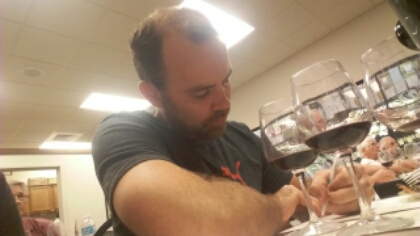
Matt and I went to a wine tasting on Saturday. We were able to sample 7 spectacular Italian wines. This was my first wine tasting at Total Wine. I enjoyed it quite a lot.