Good times on google chat!

google chat!

good times on google chat!

We did a video chat with our friends last Sunday as we prepare for a reunion trip in Albuquerque in a couple weeks. Yun and I are looking forward to a break from the heat. And I am especially thrilled about being able to talk to people! Not something I get to do too much here given my limited use of the language.

Posted in Uncategorized | Leave a comment

John 11 Study: June 10, 2014

start: 9.10am

“After saying these things, he said to them, “Our friend Lazarus has fallen asleep, but I go to awaken him.”” (11.11)

I’ve read that sleep is not an unusual metaphor for death in the ancient world and it certainly seems common enough in the Bible. For instance:

  1. “And many of those who sleep in the dust of the ground will awake, these to everlasting life, but the others to disgrace and everlasting contempt. Dan 12:2
  2. Ps 90:5 Thou hast swept them away like a flood, they fall asleep
  3. Mt 9:24 He began to say, “the girl has not died, but is asleep.” And they began laughing at Him.
  4. Mt 27:52 tombs were opened; and many bodies of the saints who had fallen asleep were raised;
  5. Ac 7:60 “Lord, do not hold this sin against them!” And having said this, Stephen fell asleep.
  6. Ac 13:36 “For David … fell asleep, and was laid among his fathers, and underwent decay
  7. 1 Co 15:6,18,20,51 some have fallen asleep … those who are asleep, we shall not all sleep,
  8. 1 Th 4:13-15 those who are asleep … have fallen asleep in Jesu
  9. 2 Pe 3:4 ever since the fathers fell asleep
  10. “whether we are awake or asleep, we may live together with Him.” 1 Th 5:10

Mark 5:39 and Luke 8:52 are perhaps a bit more confusing.

“The child has not died, but is asleep.”

Here the contrast seems to be between death and sleep, which has led some to believe the official’s daughter wasn’t really dead and that Lazarus was the first to be raised from the dead. But I’m not so sure. Recalling verse 4 of chapter 11, Jesus said:

“But when Jesus heard it he said, “This illness does not lead to death. It is for the glory of God, so that the Son of God may be glorified through it.”

We were never told that the 12-year-old girl of Mark 5 was actually dead. In Mark 5.23 she is described as dying, but not dead. Luke 8 says the same thing. But in regard to Lazarus, we are specifically told he was dead (and for four days) in verses 13, 14, 16, 17, 21, 32, 37, and 39.

Lazarus really died. But Jesus said in verse 3, “This illness does not lead to death” and in verse 25 he says, “Whoever believes in me, though he die, yet shall he live.” and verse 26, “and everyone who lives and believes in me shall never die.

Lazarus’ illness does not lead to death.
Lazarus has died.
Everyone who lives and believes in Jesus shall never die.
Whoever lives and believes in Jesus will die and yet shall live.

To understand what Jesus is saying here requires an understanding of the following:

1. What am I?
2. What is death?

Am I something more than physical matter? Paul describes the body as a tent in 2 Cor. 5:

“For we know that if the tent that is our earthly home is destroyed, we have a building from God, a house not made with hands, eternal in the heavens.” (5.1)

So we are always of good courage. We know that while we are at home in the body we are away from the Lord” (5.6)

I don’t believe we cease to exist when our earthly tent is destroyed (ie, dead). We’ve been promised a future resurrected body.

12 Now if Christ is proclaimed as raised from the dead, how can some of you say that there is no resurrection of the dead? 13 But if there is no resurrection of the dead, then not even Christ has been raised. 14 And if Christ has not been raised, then our preaching is in vain and your faith is in vain. 15 We are even found to be misrepresenting God, because we testified about God that he raised Christ, whom he did not raise if it is true that the dead are not raised. 16 For if the dead are not raised, not even Christ has been raised. 17 And if Christ has not been raised, your faith is futile and you are still in your sins. 18 Then those also who have fallen asleep in Christ have perished. 19 If in Christ we have hope in this life only, we are of all people most to be pitied.” (1Cor 15.12-19)

Sleep is a metaphor for the period of time between the destruction of our earthly tent and the possession of our resurrected or spiritual body (see 1Cor 15.35-49). Lazarus’ earthly tent was dead. It no longer functioned. As such, he was buried. But Lazarus did not cease to exist. Other passages describe that period as sleep. Not an unconscious activity. The parable of the other Lazarus and the rich man demonstrate that point.

Lazarus’ illness does not lead to death.

That is, Lazarus’ illness does not end his existence. It led to sleep. And temporal sleep at that (ie, 4 days).

Lazarus has died.

His earthly tent has been destroyed. It no longer functions and as such, it begins to rot.

What am I?

I am a person. I was created in the image of the Creator. I was given a temporal form, an earthly tent, that will soon cease to exist. By the blood of Christ, I have been promised a future resurrected body. A spiritual body. Imperishable. Immortal.

What is death?

Death is the end of my earthly tent. It denotes my departure from my current body. A period of time where I await the sound of the last trumpet.

It would have been pretty spectacular to have been able to speak with Lazarus subsequent to being raised from the dead. Was he allowed to speak of the experience? We don’t know. The text doesn’t say. What did he see? Where did he go? What was his life like after that experience?

/end 10:21am

Posted in John 11, studies | Leave a comment

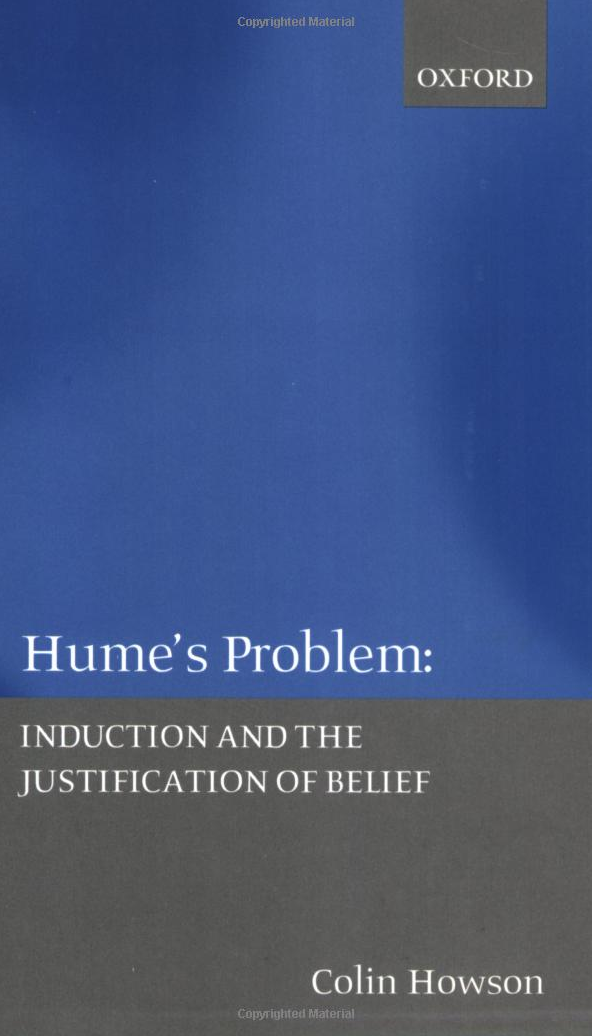
Book: Hume’s Problem: Induction and the Justification of Belief

Screen Shot 2014-06-09 at 7.57.38 AM

Matt and I have had conversations lately where Hume has made an appearance and as such, it prompted me to read a more modern (published in 2000) attempt to deal with the devastation Hume dealt to the justification of the inductive process.

Howson is a philosophy professor at the University of Toronto. He is an atheist who has written a critique of theistic teleological and cosmological arguments. His academic interests have been the philosophy of logic and probability philosophy. The former is of particular interest for me, but Howson has no published work on the subject (though he used to be a professor of logic at the London School of Economics).

Here are some interesting quotes from this book:

“Kant saw the necessity imposed as a condition of thinking and of perception. Kant proposed in the Critique of Pure Reason that a so- called transcendental argument can be used to establish that what seem to be very general factual principles, like that which says that every event has a cause, and even more specific ones like the Newtonian laws of mechanics and gravitation, are necessary because they are preconditions of knowledge, the inbuilt framework within which we structure experience.

Answer. The problem with Kant’s theory is the undeniable fact that we can sensibly and consistently conceive alternatives to the principles Kant held to be ‘necessary’ conditions of cognizing—the ‘law’ of cause and effect, Newtonian gravitational theory, and Euclidean geometry as the only possible geometry for space—all of which, moreover, are now deemed false! In other words, the Kantian ‘transcendental deduction’ is unsound. Furthermore, even if there were ever a sound deduction, it would have to employ some non- tautological premisses, and we should then need to enquire how they were established (at this point Hume enters again). Either that or there is an infinite regress of justification, and nothing is achieved.”

I agree with Howson’s critique of Kant’s transcendental reasoning (ie, for the preconditions of human intelligibility). The Kantian TA is unsound, but that doesn’t entail that TAs themselves, as a method to ground beliefs, are unsound.

Further, Howson states they would need to employ some non-tautological premises (ie, non-circular), but doesn’t substantiate why that must be the case (he simply appeals to Hume’s devastation of induction). TAs are not the same as a traditional, linear deductive argument. If they were, then they would in fact result in the problem of infinite regress.

He seems to recognize the soundness of ‘rule-based circularity’ (an appeal to the work of the later reliabilists) when he says:

“Hence there are inductive arguments which, though rule-circular, are not viciously circular: they can give you a justified belief in their conclusions without requiring justified belief in their own soundness.”

Since circularity is an inevitable consequence of any form of reasoning, it’s a helpful admission that Howson presents at the beginning of the book.

Posted in books, studies | Leave a comment

Book: The Structure of Biblical Authority

910698

I finished this book a number of weeks ago. I really thought it was well written and presented some stellar insights. I’ve never read anyone like Kline with the level of sophistication he brings on the topic of covenant. I’m not sure there is anyone better really. I keep the book on my desk to review my highlights from time-to-time. Many good things to think about.

On coventantal parallelism and administrations:

“The scene of the Sermon on the Mount, which epitomizes Jesus’ authoritative teaching role, recalls on mistakenly the figure of Moses at Mount Sinai.” (192)

“Even when stating the contrast between Moses and Jesus Christ in terms of law over against grace and truth, John draws attention to their common mediatorial role. It was “through” Moses and “through” Christ that the Old and New Covenant came.” (190)

Posted in Uncategorized | Leave a comment

Book: Covenant Theology: A Baptist Distinctive

index

Reformed Baptists are such a refreshing change from the madness of the dispensational branch that has grown out of control in the last 100-150 years. Mexico has very few reformed Baptists, but that seems to be changing.

Our church would probably most closely identify with that of a Reformed Baptist. It’s not ideal, particularly due to the dangers of the polity, but it’s what we have.

I’ve been trying to understand the differences between the Presbyterian (with which I would identify) and Baptist covenantalism. They are, historically, similar in many ways. And as such, the early Baptist confessions are nearly identical to the Westminster Standards.

Even so, I’m trying to find the better arguments for baptistic covenantalism. So far this book has not been very impressive in that its intended audience is someone that has very little familiarity with the subject. Nonetheless, here’s a helpful start at identifying the difference in the two forms of covenantalism:

“Just before God promised his ancient prophet a New Covenant, he made a declaration of a change in administration of the covenant of grace. The change has to do with God’s matter of dealing with children. Notice exactly the wording of this proverb, one that was common in ancient Israel: “The fathers have eaten sour grapes and the children’s teeth are set on edge.” In the past, this passage tells us, God dealt with children according to the status and actions of their fathers. If a father was a member of the Covenant, so were the children. If the father was obedient or transgressed, the children also were blessed or suffered punishment accordingly. Jeremiah 31:29-30 teachers that such would not be a matter of dealing with people in the New Covenant. As the Prophet States in verse 30, “But each one shall die for his own iniquity; every man who eats the sour grapes, his teeth should be set on edge.” This instructs unmistakeably that in the New Covenant each person will be dealt with individually, whether his father is a believer or not, or whether his father has sinned or not. The standing of the father before God will have utterly no bearing on the place of the child and covenant dealings. The implications of this are far-reaching: a child would not automatically be included in the Covenant by birth or baptism, or simply because his father is a covenant member. By the same token, if a child is a member of a visible Church in New Covenant days in his father’s excommunicated, the child is not cast out along with the father.” (pp50-51)

Posted in books, studies | Leave a comment

So unnatural…so good.

Screen Shot 2014-06-03 at 7.59.51 AM

We hit 117 yesterday. That’s pretty hot. So last night we decided to go out for a snack. What came to my mind as a tasty snack on a hot day is not what is pictured above. But to demonstrate my courage, I ordered it anyway. I have no idea what it’s called. But it was actually quite spectacular.

The contents include coconut, jicama, green olives, cucumbers, and peanuts. All of which is saturated in clamato juice with spicy tamarindo powder around the edge of the cup. I could go for another one of these tonight.

Posted in Uncategorized | Leave a comment

John 11 Study: June 3, 2014

walklight

Start: 7:07am

“But if anyone walks in the night, he stumbles, because the light is not in him.” (11.10)

Jesus had said earlier in John 8:

Again Jesus spoke to them, saying, “I am the light of the world. Whoever follows me will not walk in darkness, but will have the light of life.” (8.12)

Walking implies a destination. Walking in the light implies moving toward and eventually arriving at that destination. What is the destination for those in the dark? For them, it’s as though the stumbling itself was the destination. There is no direction. No ultimate purpose. No movement. I struggled with the attendant existential grief when I was stumbling around in that darkness years ago. What was the point of all of this I once asked. It’s hard to live like that. Distractions were a temporal remedy from the stumbling. The distractions get old quickly though.

Psalm 27.1

The Lord is my light and my salvation;
whom shall I fear?
The Lord is the stronghold of my life;
of whom shall I be afraid?

Isaiah 9.2

The people who walked in darkness
have seen a great light;
those who dwelt in a land of deep darkness,
on them has light shone.

“Relying on this protection, therefore, Christ advances boldly into Judea, without any dread of being stoned; for there is no danger of going astray, when God, performing the part of the sun, shines on us, and directs our course.

“We are taught by these words, that whenever a man allows himself to be guided by his own suggestions, without the calling of God, his whole life is nothing else than a course of wandering and mistake; and that they who think themselves exceedingly wise, when they do not inquire at the mouth of God, and have not his Spirit to govern their actions, are blind men groping in the dark; that the only proper way is, to be fully assured of our divine calling, and to have always God before our eyes as our guide.This rule of regulating our life well is followed by a confident expectation of a prosperous result, because it is impossible that God shall not govern successfully. And this knowledge is highly necessary to us; for believers can scarcely move a foot to follow him, but Satan shall immediately interpose a thousand obstructions, hold out a variety of dangers on every side, and contrive, in every possible way, to oppose their progress. But when the Lord invites us to go forward, by holding out, as it were, his lamp to us, we ought to go forward courageously, though many deaths besiege our path; for he never commands us to advance without at the same time adding a promise to encourage us, so that we may be fully convinced, that whatever we undertake agreeably to his command will have a good and prosperous issue. This is our chariot, and whoever betakes himself to it will never fail through weariness; and even though the obstacles were so formidable that we could not be conveyed through them by a chariot, yet, furnished with these wings, we shall always succeed, till we reach the goal. Not that believers never meet with any adversity, but because adverse occurrences are aids to their salvation.” (Calvin, John 1-11)

End: 7:47

Posted in John 11, studies | Leave a comment

Tila hides her bone

Tila has this funny habit of burying bones that we give her. This happens even when we’re not home. We gave her a bone last weekend while at Matt and Dana’s. As always, we found it  hilarious and so I filmed her.


Posted in tila!, Uncategorized | Leave a comment

Book: The Mindbody Prescription

Needless to say, this book is controversial. I finished it a few days ago and have adopted the proposed solution to my pain issues presented within. What else do I have to lose?

I went back to my third rheumatologist this week who prescribed me much stronger pain medication and a much stronger anti-inflammatory. I wasn’t thrilled with that idea and I’ve been taking a regiment of pain medications and an anti-inflammatory for months now which has only resulted in more significant pain.

So here’s a summary of what the book presents as the problem:

1. Feelings generated in infancy and childhood permanently reside in the unconscious and may be responsible for psychological and physical symptoms throughout life.

2. Strong, painful, embarrassing and threatening feelings, like rage, grief and shame, are repressed in the unconscious.

3. Repressed emotions constantly strive to come to consciousness – that is, escape from the unconscious and become overt and consciously manifest.

4. The purpose of symptoms, physical or emotional, is to prevent repressed feelings from becoming conscious by diverting attention from the realm of the emotions to that of the physical. It is strategy of avoidance.

The controversial claim is that some of our physical or mental pain originates in the brain as a result of emotions like rage. That is, they are psychosomatic.

My shoulder problem (bursitis and tendonitis) is presented as a common problem to originate in the brain. Both of these issues have a diagnostic confirmation (and I’ve had numerous ultrasounds to confirm that a physiological problem exists). What Dr. Sarno proposes is that those physiological abnormalities do not cause the pain I am experiencing. Rather, he believes the brain reduces the amount of oxygen flow to my shoulder which gives an experience of pain. He believes the brain does this intentionally as a means to avoid dealing with difficult underlying emotions. In other words, the brain uses pain as a distraction.

This all seems a bit absurd. However, I felt as though I could identify with a number of things presented in the book. I started to track when my most intense shoulder pain would manifest. Without exception, it was always around a stressful event. I didn’t think I experienced much stress here, but there are some moments.

The solution offered by Dr. Sarno is the awareness of what the mind is up to. That sounds trite, but so far the results have been pretty shocking. As I feel the pain, I take a moment to think about what’s going on, what I’m thinking about, what might be prompting the pain, and so far there’s always been something. And just the process of thinking about what’s going on has caused the pain to go away. And the pain has been rapidly diminishing since the first day (a couple days ago). I have total control of both of my arms now and feel less pain than I have in months. And I stopped taking my medication two days ago. So perhaps this theory is legit.

Posted in books, studies | Leave a comment

Tucson Food Traditions

We were able to visit Tucson last Thursday for a couple days. It’s been months since we’ve been able to visit, so it was long past due. The highlight of course is seeing our friends and eating a lot of food. As always, we stayed with Matt and Dana.

We arrived Friday for some homemade pizzas. They were so very good. Even more so with an abundance of wine. Finally Yun found a white she likes and even consumed multiple glasses (gasp!).

friday night pizza yo   pizza with wine equals magical

Friday was spent shopping. It’s always an uncomfortable experience for me to do months of shopping in one day. We get a lot of stuff (as much as the car will hold). We are trying to ween ourselves off of our dependence of things from the US. The challenge is that many things are much cheaper and/or much better quality. Also, there are just some things you can’t get here. Like yellow cheese and russet potatoes.

We have a tradition now with the Mcreynolds of a steak dinner with potatoes on each visit (either here or there). I very much love this tradition. We had some filets and my perfectly prepared potatoes (minus the spicy heat due to incessant complaining). Such a good meal. Such good wine.

raw yummyness    papa madness

traditions are awesome

And as always, we were able to smoke the necessary number of cigars for proper digestion. Matt has the best humidor and I have claimed his top shelf as my own.

digestion help

Posted in Uncategorized | 2 Comments